

Blick auf Planetenentstehung: Kollisionen in jungem Planetensystem erstmals beobachtet

Blick auf Planetenentstehung: Kollisionen in jungem Planetensystem erstmals beobachtet
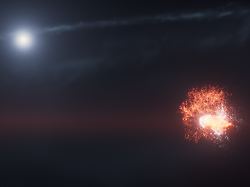
NASAs Hubble Space Telescope HST Captured The Dramatic Aftermath Of Colliding Space Rocks Within A Nearby Planetary System For The First Time When Astronomers Initially Spotted A Bright Object In The Sky They Assumed It Was A Dust Covered Exoplanet Reflecting Starlight But When The Exoplanet Disappeared And A New Bright Object Appeared The International Team Of Astrophysicists Including Northwestern Universitys Jason Wang Realized These Were Not Planets At All Instead They Were The Illuminated Remains Of A Cosmic Fender Bender Two Distinct Violent Collisions Generated Two Luminous Clouds Of Debris In The Same Planetary System The Discovery Offers A Unique Real Time Glimpse Into The Mechanisms Of Planet Formation And The Composition Of Materials That Coalesce To Form New Worlds Spotting A New Light Source In The Dust Belt Around A Star Was Surprising We Did Not Expect That At All Wang Said Our Primary Hypothesis Is That We Saw Two Collisions Of Planetesimals Small Rocky Objects Like Asteroids Over The Last Two Decades Collisions Of Planetesimals Are Extremely Rare Events And This Marks The First Time We Have Seen One Outside Our Solar System Studying Planetesimal Collisions Is Important For Understanding How Planets Form It Also Can Tell Us About The Structure Of Asteroids Which Is Important Information For Planetary Defense Programs Like The Double Asteroid Redirection Test DART This Is Certainly The First Time Ive Ever Seen A Point Of Light Appear Out Of Nowhere In An Exoplanetary System Said Lead Author Paul Kalas An Astronomer At The University Of California Berkeley Its Absent In All Of Our Previous Hubble Images Which Means That We Just Witnessed A Violent Collision Between Two Massive Objects And A Huge Debris Cloud Unlike Anything In Our Own Solar System TodayDas Weltraumteleskop Hubble beobachtet zwei Kollisionen in nur 20 Jahren – diese Art von Zusammenstößen tritt eigentlich nur alle 100.000 Jahre einmal auf. Die Aufnahmen aus dem Sternensystem Fomalhaut stellen gängige Modelle der Planetenentstehung auf den Kopf.


Ähnliche Beiträge

Schreibe einen Kommentar

Deine E-Mail-Adresse wird nicht veröffentlicht. Erforderliche Felder sind mit * markiert